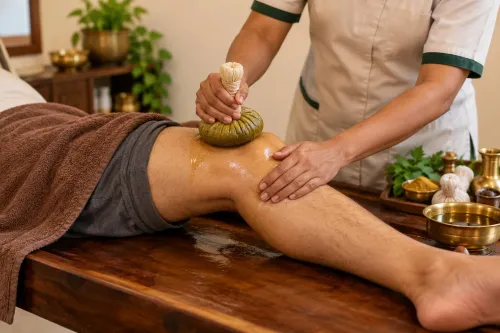

Lower back discomfort lasting 12 weeks or longer deserves more than repeated self-treatment, especially when pain travels into a leg or affects strength, sensation, sleep or movement. You will learn how to recognise urgent warning signs, prepare for a proper evaluation and decide when an Ayurvedic programme could complement—not replace—diagnosis and indicated medical care.
Key takeaways
- Seek urgent care for leg weakness, saddle numbness, or bladder and bowel changes.
- Record pain location, triggers, severity, duration, and symptoms before evaluation.
- Expect Ayurvedic assessment to review your history, examination findings, and individual health pattern.
- Judge progress by pain, movement, sleep, and daily function—not pain intensity alone.
What kind of lower back pain are you experiencing?
Pain confined to the lower back and linked to movement, lifting or posture is usually mechanical lower back pain, but the pattern matters. Compare these common presentations:
| Pattern | Clues that support it | What it does not prove |
|---|---|---|
| Mechanical lower back pain | Aching across the low back; changes with bending, sitting, standing or activity; no numbness or weakness | A specific damaged structure |
| Muscle strain | Begins after lifting, twisting or unusual exertion; local tenderness and pain when the muscle contracts or stretches | That imaging is needed |
| Disc-related pain | Back pain with buttock pain, often worse with sitting, bending, coughing or sneezing | That every disc bulge causes symptoms |
| Spinal arthritis | Stiffness and reduced movement, with pain during standing or walking; often worse after inactivity | That pain is simply age-related |
| Spondylitis | Morning stiffness lasting more than 30 minutes, night pain, improvement with movement, or alternating buttock pain | A diagnosis without examination |
| Sciatica | Burning or electric pain travelling from the back or buttock down one leg, with tingling, numbness or weakness | Ordinary muscle soreness |
These patterns overlap, so persistent lower back discomfort lasting 12 weeks or longer deserves clinical assessment. Ayurvedic terms such as Vata disorder or kati shoola do not map exactly onto these diagnoses.
Seek urgent assessment for new bladder or bowel-control problems, saddle numbness, progressive leg weakness, fever, unexplained weight loss, major trauma, or a history of cancer or serious infection.
Which symptoms require urgent assessment, and how long should you wait?
New urinary retention, loss of bladder or bowel control, saddle numbness, or progressive weakness in both legs requires emergency assessment now. These are possible signs of cauda equina syndrome, where delaying treatment can cause permanent nerve damage. Do not wait for an Ayurvedic appointment or try Panchakarma first.
Seek prompt medical review for these warning features:
- New or worsening sciatica symptoms with numbness and tingling, reduced sensation, or leg weakness
- Fever, unexplained weight loss, a history of cancer, immunosuppression, intravenous drug use, or prolonged corticosteroid treatment
- Major trauma, or back pain with known osteoporosis
- Pain that is rapidly worsening, severe at night, or accompanied by marked illness
| Situation | What to do | How long to wait |
|---|---|---|
| Bladder or bowel changes, saddle numbness, or weakness in both legs | Go to an emergency department | Immediately |
| New neurological symptoms, fever, cancer history, major trauma, or rapidly worsening pain | Arrange a doctor’s assessment | Today or within 24 hours |
| Persistent pain without warning signs | Book an evaluation to identify mechanical pain, disc disease, stenosis, inflammatory disease, fracture, infection, or malignancy | At 12 weeks, or sooner if function is declining |
| Mild, stable back pain without red flags | Continue appropriate activity and self-management while arranging routine advice | Do not delay review if it worsens |
An Ayurvedic programme should follow, not replace, diagnostic assessment when red flags or neurological symptoms are present.
What will a medical evaluation involve, and what should you record?
For pain lasting 12 weeks or longer, a clinician will take a detailed history and perform a musculoskeletal and neurological examination before ordering tests. They will assess movement, spinal tenderness, walking, sensation, strength and reflex testing, and may use the straight-leg-raise test to check for nerve-root irritation.
| Finding | What it may suggest | Usual next step |
|---|---|---|
| Pain confined to the back | Nonspecific mechanical pain or muscle strain | Activity advice, exercise and monitoring |
| Pain travelling into the buttock or leg | Radicular pain, such as sciatica | Neurological assessment and review of progression |
| Stiffness with systemic symptoms | Inflammatory disease or infection | Prompt medical investigation |
| Pain after major trauma or with fracture risk | Possible vertebral fracture | Urgent assessment and imaging |
| Persistent pain with neurological deficit | Nerve compression or spinal stenosis | Specialist review; MRI for back pain if the result could change treatment |
Bring a written record rather than relying on memory. Include:
- When the pain began, whether it is constant, and whether it is worsening
- Pain location, severity from 0 to 10, triggers, relieving positions, sleep disruption and walking tolerance
- Numbness, tingling, weakness, stiffness, bladder or bowel changes, fever, weight loss, trauma, cancer or infection history
- Treatments tried, including exercise, medicines, injections and their effects
- Every current medicine or supplement, allergies, major illnesses and pregnancy status
Routine X-rays or MRI are not needed for uncomplicated back pain when results will not alter management. An Ayurvedic assessment should complement, not replace, this evaluation.
What happens during an Ayurvedic assessment and treatment programme?
Pain lasting 12 weeks or longer needs more than a constitutional label. During an Ayurvedic assessment for back pain, the practitioner should ask about onset, movement-related pain, leg symptoms, numbness, weakness, bladder or bowel changes, fever, injury, medicines and previous reports. They should perform a neurological and musculoskeletal examination.
1. Establish suitability. Confirm whether the pattern is uncomplicated mechanical pain, radicular pain, spinal stenosis, inflammatory disease, fracture, infection or another condition needing medical care. Terms such as Kati shoola and Vata disorders guide Ayurvedic treatment selection; they do not replace a diagnosis or indicated MRI, X-ray or specialist review.
2. Agree on a plan. Ask exactly which components are proposed: oil application, massage, heat, exercises, dietary changes, medicines or Panchkarma for back pain. Clarify the number and length of visits, home-work requirements, expected review date and what improvement will be measured, such as walking time, sleep or leg pain.
3. Check safety. Give the practitioner a complete medicine and supplement list, pregnancy status, allergies, liver or kidney disease and other conditions. Do not stop prescribed treatment or beneficial exercise without the treating clinician’s agreement.
4. Set a stopping rule. Seek urgent medical care for new urinary retention, incontinence, loss of bowel control, saddle numbness or progressive weakness in both legs. Omkar Ayurved can discuss coordination with medical care when those findings or an uncertain diagnosis make Panchkarma unsuitable.
Evidence for Ayurveda as a complete treatment package remains limited, so review progress rather than committing indefinitely.
Related service
Ayurvedic Treatment Spondylits/Sciatica/Vertebral Coloumn Disorder Ayurvedic Treatment For Spondylits/Sciatica/Vertebral Coloumn Disorder Spondilitis is the result of an inflammation of the vertebral joints. View service → |
How can you judge whether Ayurvedic care is helping?
Set a review date before starting, and record your baseline for seven days. Ayurvedic treatment for chronic back pain should complement proven self-management, not replace medical care, prescribed medicines, or rehabilitation. Continue structured exercise, use activity modification to avoid movements that clearly worsen symptoms, and keep normal activities within tolerable limits.
Define treatment goals for back pain in measurable terms:
- Walk for 20 minutes without needing to stop.
- Sleep for a stated number of hours without waking from pain.
- Complete a work shift or a specific household task.
- Reduce pain on a 0-to-10 scale.
- Use fewer rescue pain medicines, if your prescriber agrees.
- Improve your score on a validated disability questionnaire, such as the Roland-Morris Disability Questionnaire.
Repeat the same measures on the agreed review date. Continue the programme only if function, sleep, disability, or medicine use is improving without unacceptable side effects; pain relief alone is less convincing if you still cannot do more.
Relief immediately after oil massage or heat can be temporary and does not prove that the underlying cause has changed.
Evidence for Ayurveda as a complete treatment system remains limited, and combined programmes cannot show which element caused improvement. Treat claims that Panchakarma detoxifies the spine, fixes a disc problem, or prevents surgery as unproven. New weakness, numbness, fever, or rapidly worsening pain requires medical review rather than extending the trial.
Frequently asked questions
What kind of lower back pain are you experiencing?
Movement-, lifting-, or posture-related pain is often mechanical. Note whether pain spreads into a leg, follows an injury, or occurs with fever or unexplained weight loss.
Which lower back pain symptoms require urgent assessment?
Seek urgent medical assessment for new leg weakness, numbness around the groin or inner thighs, loss of bladder or bowel control, fever with severe back pain, or major trauma.
How long should you wait before seeking care for lower back pain?
Seek care sooner for warning signs. Arrange an evaluation when pain persists, worsens, repeatedly returns, or limits sleep, work, walking, or routine activities.
What will a medical evaluation involve?
A clinician will review your symptoms and history, examine movement, strength, sensation, reflexes, and walking, then decide whether tests or imaging are needed.
What happens during an Ayurvedic assessment and treatment programme?
The practitioner reviews your pain pattern, health history, digestion, sleep, activity, and examination findings before proposing personalised measures such as medicines, therapies, exercises, or Panchkarma.